For research use only · Not for human use
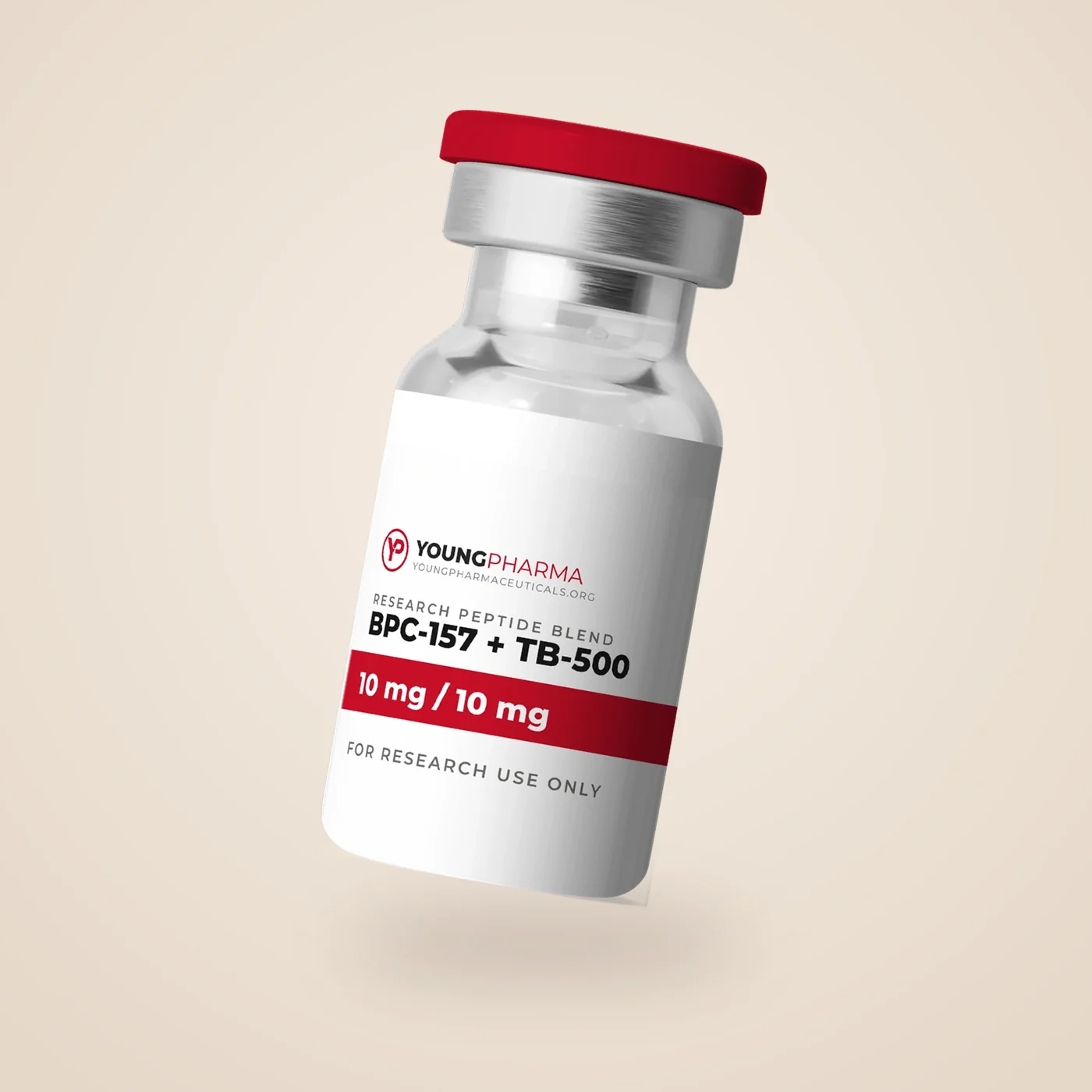
BPC-157 + TB-500
Two-peptide blend for tissue-repair research
In short
Combines BPC-157 and TB-500 (a synthetic fragment of thymosin beta-4) in one vial. The two are often studied together in tissue-repair research.
Evidence level: Mostly preclinicalData for both components comes mainly from animal and cell studies.
Size
- Independently tested. Janoshik Analytical results published.
- QR verification. An authenticity code on every box.
Blend components
| Component | CAS# | Formula | Molar mass |
|---|---|---|---|
| BPC-157 | 137525-51-0 | C62H98N16O22 | 1419.55 g/mol |
| TB-500 | 77591-33-4 | C212H350N56O78S | 4963.44 g/mol |
The current batch certificate for this product is not yet published on the site. Send us your lot number and we'll share it.
Request certificateWhat is BPC-157 + TB-500?
A two-peptide research blend combining BPC-157 and TB-500. Each component has been examined in preclinical publications for interactions with distinct molecular pathways — BPC-157 for VEGFR2 and nitric-oxide signaling, and TB-500 for G-actin sequestration.
This blend combines two peptides that were discovered decades apart but ended up being natural partners in research. BPC-157 came from Croatian scientists in the early 1990s who were studying the protective properties of stomach fluid. TB-500, on the other hand, traces back to the 1960s when Dr. Allan Goldstein and his team at the National Institutes of Health were exploring the thymus gland and discovered a family of peptides called thymosins.
Researchers noticed that these two peptides seemed to tackle tissue repair from different angles. BPC-157 has been studied for its interactions with angiogenic signaling pathways in preclinical models. TB-500 has been researched for its role in actin regulation and cellular migration—mechanisms that are of interest in tissue repair research. Scientists started wondering: what if you used both at once?
Studies combining the two peptides have appeared in preclinical wound-model and musculoskeletal-model research. This product is intended for research use only.
How should BPC-157 + TB-500 be stored?
Research peptides are supplied lyophilized (freeze-dried) . Keep sealed vials cool, dry, and protected from light until reconstitution.
After reconstitution, refrigerate prepared solutions and use sterile technique. For general laboratory diluent and handling notes, see lyophilized peptide reconstitution .
Related research compounds
References
- Brcic L, Brcic I, Staresinic M, et al. Modulatory effect of gastric pentadecapeptide BPC 157 on angiogenesis in muscle and tendon healing. J Physiol Pharmacol. 2009;60 Suppl 7:191-196. PMID 20388964
- Staresinic M, Petrovic I, Novinscak T, et al. Effective therapy of transected quadriceps muscle in rat: Gastric pentadecapeptide BPC 157. J Orthop Res. 2006;24(5):1109-1117. PMID 16609979
- Goldstein AL, Hannappel E, Sosne G, Kleinman HK. Thymosin beta4: a multi-functional regenerative peptide. Basic properties and clinical applications. Expert Opin Biol Ther. 2012;12(1):37-51. PMID 22074294
- Bock-Marquette I, Saxena A, White MD, et al. Thymosin beta4 activates integrin-linked kinase and promotes cardiac cell migration, survival and cardiac repair. Nature. 2004;432(7016):466-472. PMID 15565145
- Sikiric P, Seiwerth S, Rucman R, et al. Stable gastric pentadecapeptide BPC 157: novel therapy in gastrointestinal tract. Curr Pharm Des. 2011;17(16):1612-1632.
- Sosne G, Qiu P, Goldstein AL, Wheater M. Biological activities of thymosin beta4 defined by active sites in short peptide sequences. FASEB J. 2010;24(7):2144-2151.
BPC-157 + TB-500 is available for laboratory research purposes only.