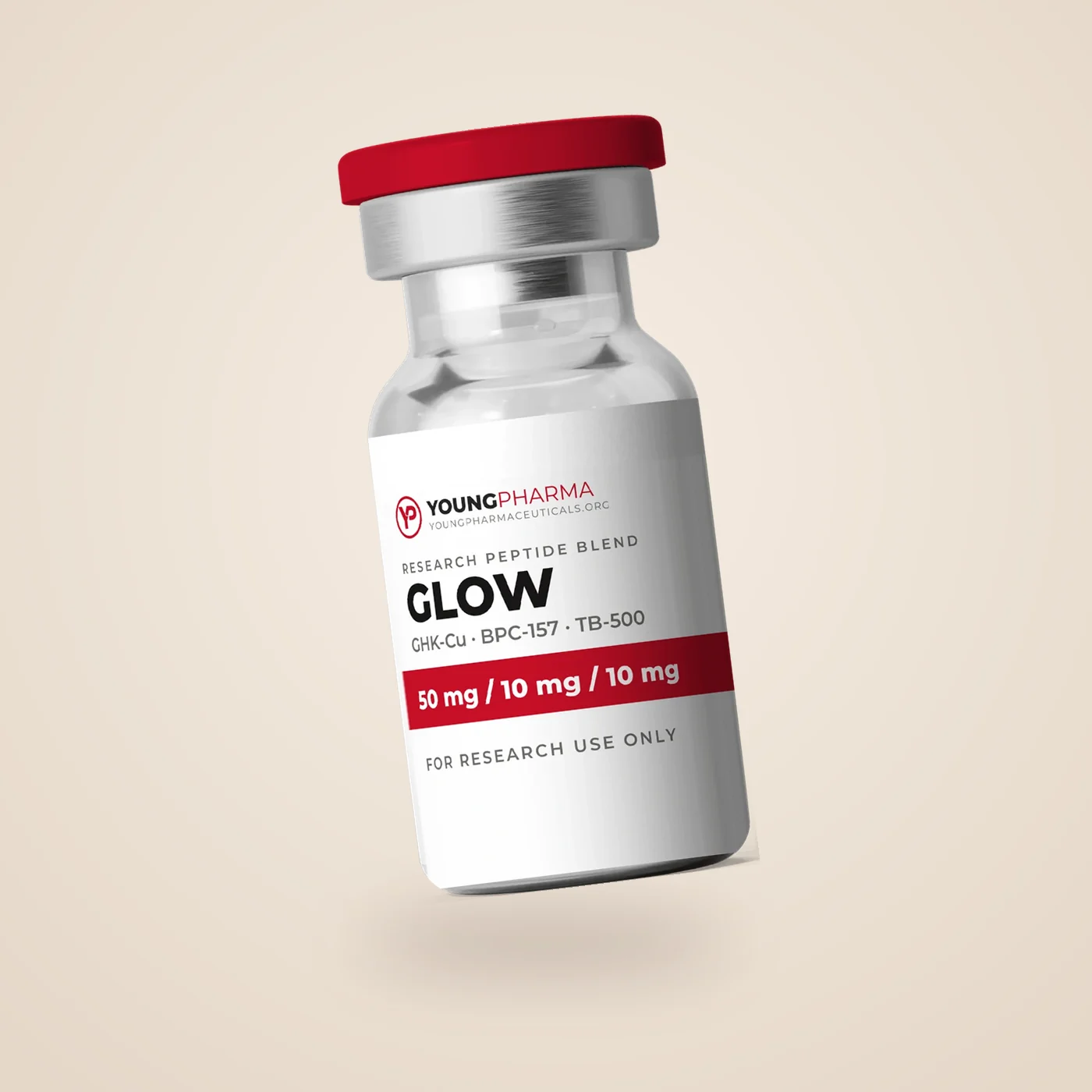
For research use only · Not for human use
GLOW
Three-peptide blend for skin and tissue research
In short
GLOW is a research blend that combines GHK-Cu, BPC-157 and TB-500 in one vial, bringing together three peptides used in skin, collagen and tissue-repair studies.
Evidence level: Mostly preclinicalThe components have been studied individually; there are no clinical studies of this blend itself.
Size
- Independently tested. Janoshik Analytical results published.
- QR verification. An authenticity code on every box.
Blend components
| Component | CAS# | Formula | Molar mass |
|---|---|---|---|
| BPC-157 | 137525-51-0 | C62H98N16O22 | 1419.55 g/mol |
| TB-500 | 77591-33-4 | C212H350N56O78S | 4963.44 g/mol |
| GHK-Cu | 49557-75-7 | C14H22CuN6O4 | 401.91 g/mol |
The current batch certificate for this product is not yet published on the site. Send us your lot number and we'll share it.
Request certificateWhat is GLOW?
GLOW is a multi-peptide research blend for studying tissue remodeling, cellular migration, and collagen synthesis pathways in vitro. It combines BPC-157, TB-500, and GHK-Cu to enable investigation of complementary extracellular matrix signaling mechanisms.
GLOW is a blend that brings together three peptides that were each first described through separate research paths. BPC-157 emerged from Croatian gastric-juice studies in the 1990s. TB-500 (Thymosin Beta-4) traces to Allan Goldstein's thymosin work in the 1960s. GHK-Cu was first described by Dr. Loren Pickart in 1973 while studying human blood plasma.
Each peptide had built its own preclinical research base before being combined in this blend. BPC-157 has been examined in vitro and in animal models for interactions with angiogenic signaling. TB-500 has been studied for its influence on cellular migration in laboratory models. GHK-Cu has been examined in vitro for associations with gene-expression and tissue-remodeling pathways.
GLOW combines these three peptides to let researchers examine complementary in-vitro mechanisms — angiogenic signaling, cellular migration, and extracellular-matrix gene expression — within a single lyophilized preparation. This product is intended for research use only.
How should GLOW be stored?
Research peptides are supplied lyophilized (freeze-dried) . Keep sealed vials cool, dry, and protected from light until reconstitution.
After reconstitution, refrigerate prepared solutions and use sterile technique. For general laboratory diluent and handling notes, see lyophilized peptide reconstitution .
Related research compounds
References
- Pickart L, Margolina A. Regenerative and Protective Actions of the GHK-Cu Peptide in the Light of the New Gene Data. Int J Mol Sci. 2018;19(7):1987.
- Pickart L. The human tri-peptide GHK and tissue remodeling. J Biomater Sci Polym Ed. 2008;19(8):969-988.
- Sosne G, Qiu P, Goldstein AL, Wheater M. Biological activities of thymosin beta-4 defined by active sites in short peptide sequences. FASEB J. 2010;24(7):2144-2151.
- Sikiric P, et al. Stable gastric pentadecapeptide BPC 157: novel therapy in gastrointestinal tract. Current Pharmaceutical Design. 2011;17(16):1612-1632.
GLOW is available for laboratory research purposes only.