For research use only · Not for human use
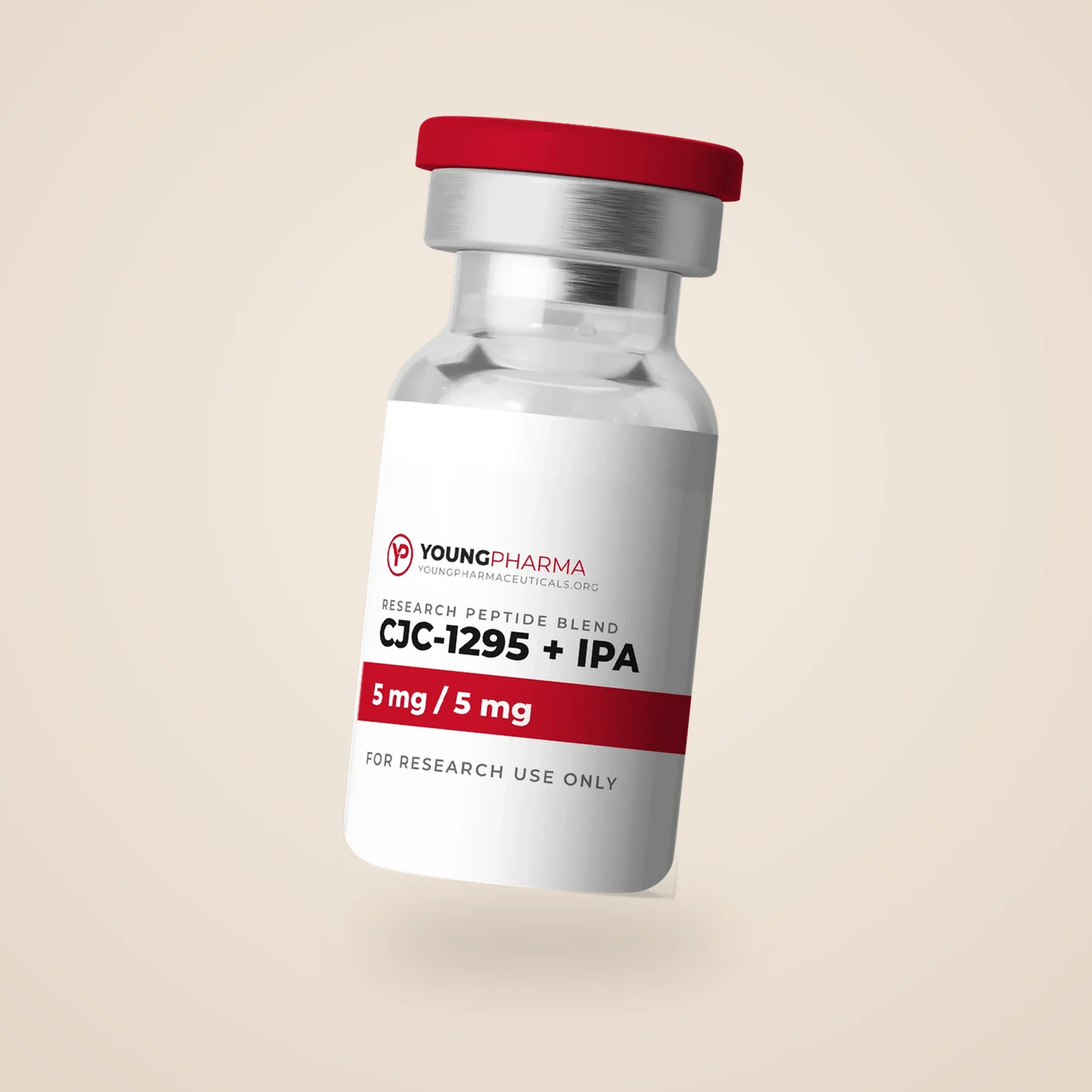
CJC-1295 + Ipamorelin
Duo for growth-hormone release research
In short
CJC-1295 mimics the body's own growth-hormone-releasing hormone (GHRH); Ipamorelin works through the ghrelin receptor. They are used together to study growth-hormone release through two different pathways.
Evidence level: Human clinical trialsBoth components have been studied in early-stage human trials; not an approved drug.
Size
- Independently tested. Janoshik Analytical results published.
- QR verification. An authenticity code on every box.
Blend components
| Component | CAS# | Formula | Molar mass |
|---|---|---|---|
| CJC-1295 | 863288-34-0 | C165H271N47O46 | 3647.28 g/mol |
| Ipamorelin | 170851-70-4 | C38H49N9O5 | 711.85 g/mol |
The current batch certificate for this product is not yet published on the site. Send us your lot number and we'll share it.
Request certificateWhat is CJC-1295 + Ipamorelin?
A two-peptide research blend combining CJC-1295, a synthetic GHRH analog, and Ipamorelin, a synthetic pentapeptide ghrelin-receptor (GHS-R1a) agonist. Each component has been examined in preclinical publications for interactions with distinct receptors involved in growth-hormone secretion signaling.
This blend brings together two peptides with different origin stories. CJC-1295 was developed by ConjuChem Biotechnologies, a Canadian biotech company, in the early 2000s as a long-acting synthetic analog of growth-hormone-releasing hormone (GHRH) for use in preclinical research.
Ipamorelin was characterized in the late 1990s by researchers at Novo Nordisk in Denmark as part of a program investigating selective growth-hormone secretagogues. Published research described it as a pentapeptide agonist at the GHS-R1a (ghrelin) receptor, noted in the literature for its selectivity relative to earlier GH-secretagogue compounds.
Subsequent preclinical publications have examined CJC-1295 for its effects on GH pulse amplitude via GHRH-receptor signaling, and Ipamorelin for its effects on pulse frequency via GHS-R1a signaling. Combination research has examined these dual-mechanism interactions at the level of the GH/IGF-1 axis in laboratory settings.
CJC-1295 and Ipamorelin continue to appear in peer-reviewed preclinical publications investigating growth-hormone-secretagogue pharmacology. This product is intended for research use only.
How should CJC-1295 + Ipamorelin be stored?
Research peptides are supplied lyophilized (freeze-dried) . Keep sealed vials cool, dry, and protected from light until reconstitution.
After reconstitution, refrigerate prepared solutions and use sterile technique. For general laboratory diluent and handling notes, see lyophilized peptide reconstitution .
Related research compounds
References
- Ionescu M, Frohman LA. Pulsatile secretion of growth hormone (GH) persists during continuous stimulation by CJC-1295, a long-acting GH-releasing hormone analog. J Clin Endocrinol Metab. 2006;91(12):4792-4797. PMID 17018654
- Teichman SL, Neale A, Lawrence B, et al. Prolonged stimulation of growth hormone (GH) and insulin-like growth factor I secretion by CJC-1295, a long-acting analog of GH-releasing hormone, in healthy adults. J Clin Endocrinol Metab. 2006;91(3):799-805. PMID 16352683
- Sinha DK, Balasubramanian A, Tatem AJ, et al. Beyond the androgen receptor: the role of growth hormone secretagogues in the modern management of body composition in hypogonadal males. Transl Androl Urol. 2020;9(Suppl 2):S149-S159.
- Raun K, Hansen BS, Johansen NL, et al. Ipamorelin, the first selective growth hormone secretagogue. Eur J Endocrinol. 1998;139(5):552-561. PMID 9849822
- Gobburu JV, Agersu00f8 H, Jusko WJ, Ynddal L. Pharmacokinetic-pharmacodynamic modeling of ipamorelin, a growth hormone releasing peptide, in human volunteers. Pharm Res. 1999;16(9):1412-1416. PMID 10496658
CJC-1295 + Ipamorelin is available for laboratory research purposes only.